The Twenty-Two Nest Assaults
Tinea and Leah: [Cyberpunk, Alien Incursions, Murder and Mayhem, Girl's Love (WLW)]The Twenty-Two Nest Assaults are the Xenocide Act VII operation in which the defenders hunt mobile Antithesis nests and confront the possibility that the underground hive has produced more advanced units than the known Twenty-Twos. Its decisive significance lies in the campaign's uncertainty: the immediate targets can be counted, but the industrial and biological capacity behind them cannot. The assault therefore becomes both a tactical extermination mission and an investigation into whether the Antithesis war has entered a new technological or evolutionary phase.
Causes and Intelligence
The campaign begins with a numerical problem. The defenders estimate that there should be two Model Twenty-Twos and are 99.94 percent certain that a third large grouping has not gained unseen members. That confidence does not make the situation safe; it defines the limit of what reconnaissance has established. The known Twenty-Twos may be the entire threat, or they may be the visible edge of a deeper production system.
The uncertainty is sharpened by the history of the underground hive. Leah identifies the fact that it built Fourteens and may also have built the Twenty-Twos, since the origin of the latter remains unknown. Her warning is operationally important: if one hive can produce double-digit models, other advanced units may be waiting elsewhere. The mobile-hive hunts thus proceed under incomplete intelligence, with every nest carrying the possibility of an undiscovered escalation.
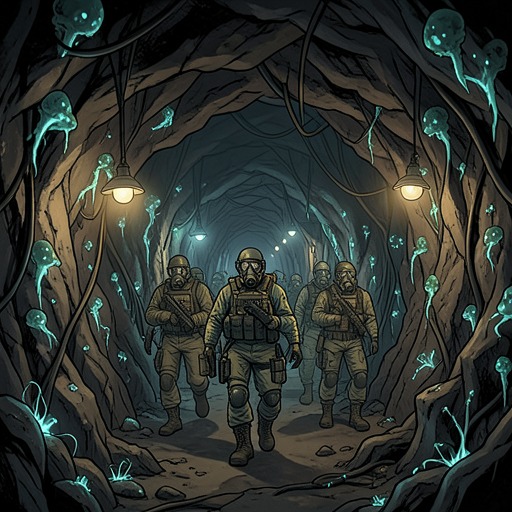
The setting reinforces that danger. One relevant Antithesis stronghold lies in the bowels of the suburb of Saint-Eustache, New Montreal, beneath the ramp leading into the megacity proper. The campaign's enemies are not merely exposed swarms in open terrain; they are rooted in concealed, subterranean spaces connected to the urban environment. This makes locating and isolating the nests as important as destroying their combat units.
Division of the Hunt
The defenders respond to uncertainty by dividing their forces. Leah proposes that they split up, a decision that transforms the campaign from a single concentrated assault into a separation hunt. The choice increases the number of places that can be searched or pressured at once, but it also distributes protection across multiple battlefields. The operation therefore depends on communication, shared tactical understanding, and weapons capable of compensating for reduced local numbers.
The assessment of the enemy is conditional rather than absolute. Leah and her allies are told that either of them could kill a Twenty-Two, while most opposing units will be single-digit models and their protections should be adequate against those lesser forms. This distinction organizes the campaign's risk: the common Antithesis can be handled through ordinary combat systems, but the Twenty-Twos remain the defining danger around which movement and engagement must be planned.
AI-I converts the plan into usable battlefield knowledge by inserting information into Leah's mind as a mental picture. The result is not merely advice delivered before combat. It is a direct merger of reconnaissance, interpretation, and action, allowing tactical information to appear as an immediately navigable spatial understanding. Later, Leah perceives every networked weapon and tool within several kilometers, along with the Sentinels' projectile-programming facilities and surviving smart bullets. The battle network has become part of her awareness, making the assault a distributed system rather than a sequence of isolated human decisions.
The Battlespace and Its Deceptions
The Antithesis fight back through sensory confusion. As Leah moves through the trees, artificial fog streams between the trunks, refractive crystals cast misleading shadows, and indistinct forms seem to move just beyond her vision. Voices and incoherent whispers join the visual interference. The battlefield is consequently designed to disrupt recognition itself: before Leah can choose a target, she must determine what counts as a target and where the threat actually is.
AI-I answers that confusion with a second, machine-readable rhythm. Pips move across a marked line as Leah realizes that the display is counting plant beasts striking the first Standoff mines. The interface turns hidden impacts into visible progress. Instead of seeing only fog, noise, and uncertain movement, Leah receives a sequence of tactical events that can be interpreted under pressure.
The campaign also relies on delegated weapons. A Sentinel can be set to full automatic fire and guided toward a chosen location, although it is initially unloaded. The arrangement makes the weapon's effectiveness dependent on a human or augmented operator's ability to designate its task. In the Twenty-Two Nest Assaults, that pattern expands: AI-I supplies awareness, networked weapons extend reach, and the fighters direct a system whose components continue acting beyond the limits of ordinary bodily attention.
Destruction of the Swarms
Once the engagement intensifies, Leah experiences a feral joy while driving lethal force through Model Fives and Model Sixes. At the same time, hundreds of thought-processes move through the back of her mind to maintain control of the battle. The two experiences coexist without cancelling one another. Combat exhilaration occupies the foreground, while distributed calculation remains continuously available and unobtrusive. The assault presents mastery not as calm detachment but as the ability to hold exhilaration and precise command in the same mental space.
A localized meteor storm reduces the enemy formation to about fifty Threes, several Fours, and two badly burned Eights that still writhe in pain. The numerical detail shows both the scale of the engagement and the uneven resilience of the Antithesis hierarchy. Lower models are reduced in large numbers, while the Eights survive catastrophic damage, preserving the higher-model problem even after the surrounding swarm has been devastated.
Leah then adopts a tactic associated with Tinea. She runs broad circles around the massive Antithesis gathering, forcing the units into a clumped whirlpool while her two turrets shave away at the mass. This is not simply evasive movement. It is battlefield geometry: motion reorganizes the enemy into a more profitable target, and the turrets convert that reorganization into sustained attrition. The maneuver also carries a relational trace, since Leah is explicitly taking a page from Tinea's book; tactical knowledge travels through partnership as well as through formal AI channels.
At a critical point, the Twenty-Two appears to have rooted itself. The observation implies that the mobile-hive threat has become fixed or anchored, changing the tactical problem from pursuit to assault. Leah responds by asking Ypsilon to unlock higher-caliber ammunition and to upgrade the turrets, seeking enough force to give the weapons real impact. The point-based equipment system therefore enters the battle at the moment when ordinary firepower has reached its limit: advancement is purchased as an immediate response to enemy durability.
The newly loaded 150mm Towed Cannon fires its first cartridge into the shoulder plate of a Model Three at the center of the nearest cluster. The target is not necessarily the highest model, but the shot is aimed at the formation's mass, using extreme force to break the concentration that makes the swarm dangerous. Leah maintains continuous fire for roughly ten seconds. By the end of that interval, no Antithesis unit is even twitching except the massive Eights, whose bodies are carved by huge divots and holes but remain otherwise intact.
Consequences and Significance
The assault's immediate consequence is overwhelming local destruction, but its deeper result is less conclusive. The defenders can annihilate large formations, survive sensory warfare, coordinate distributed weapons, and escalate from turrets to a 150mm cannon. Yet the campaign never loses sight of the unresolved question of origin. If the underground hive created Fourteens and possibly Twenty-Twos, destroying one rooted formation does not establish that the production network has ended.
The operation also exposes the cost of separation. Splitting up allows the defenders to pursue multiple mobile nests, but it requires each combatant to function as a node in a larger network. AI-I's mental mapping, Leah's expanded awareness of nearby weapons, Ypsilon's role in unlocking ammunition, and the Sentinel's automated fire all redistribute agency across bodies, software, weapons, and rules. The decisive actor is therefore not a single fighter but a temporarily coherent assemblage whose parts must remain connected under attack.
The Antithesis themselves are not represented only as anonymous targets. Elsewhere, their subterranean life is rendered through birth-fluid sacks, newly emerged individuals, scent recognition, and collective acceptance into the nest. Against that biological continuity, the Twenty-Two Nest Assaults impose a human-directed logic of tracking, separation, unlocking, and extermination. The campaign's violence is tactically exhilarating, but its structure is also a clash between two systems of reproduction: the Antithesis hive produces and recognizes new bodies, while the defenders convert destruction into points, upgrades, and increasingly elaborate instruments of control.
In that sense, the Twenty-Two Nest Assaults are both a successful battlefield sequence and a warning. The known nests can be hunted; the known swarms can be erased; even higher models can be damaged. But the 99.94 percent certainty that limits the enemy count also marks the boundary of knowledge. The campaign ends its local engagements with the Antithesis formations shattered, while leaving the wider question of what else the hive has built—and where those creations may be waiting—deliberately alive.